Resources for Whole-Person Care
A place to pause.
A starting point to grow.
Practical tools, thoughtful videos, and deeper reading to help you bring meaning, purpose, spirituality, and human connection into your practice.
For dietitians, nurses, health coaches, and educators.
Start with what you need today.

Begin here
Small steps. Meaningful conversations.
Choose a practical guide or a short introduction to bring whole-person care into focus.
Free guide
4 Simple Steps to a Whole-Person Conversation
A clear framework for noticing spiritual needs, exploring what matters, and responding with compassionate presence.
NOTICE · EXPLORE · SUPPORT · INTEGRATE
Free video · 30 minutes
A practical introduction to spiritual care
Explore what spiritual care is, how it goes beyond religion, and how it fits within your professional role.
Practical Spirituality and Health in Lifestyle Medicine & Nutrition
Whole-person care includes you
Your Wisest, Wellest Self Tracker
A gentle invitation to pause, reflect, and reconnect with your own meaning and energy.
Explore clinical applications
See whole-person care in different settings.
Free recorded videos exploring meaning, purpose, and spirituality in patient care.
Free on-demand video
Spiritual care in weight management
Explore how meaning, purpose, and spiritual well-being can inform conversations about lifestyle change.
Spiritual Care: The Missing Link in Caring for Overweight Patients through Lifestyle Medicine:
Patients often know what to do, but struggle with the how of lasting change. When treating obesity, the missing link is often meaning, purpose, and spiritual well-being—drivers rarely addressed in clinical weight management.
This free on-demand video offers an innovative perspective on obesity care by applying newly published competencies in Meaning, Purpose, and Spirituality. Learn how to move beyond caloric mechanics to ignite the internal motivation necessary for sustainable, whole-person transformation.
Free on-demand video
Creating a Life of Intent with Type 2 Diabetes
Consider how a patient's sense of meaning and purpose can become part of whole-person diabetes care.
Most Type 2 Diabetes training focuses strictly on clinical metrics like A1C, yet many patients still face burnout. The "missing link" is existential well-being—the deeper sense of meaning and purpose that fuels long-term resilience.
In this free video, "Creating a Life of Intent with Diabetes," we explore how to bridge the gap between medical management and a patient’s internal drive. Discover an innovative approach for clinicians who want to move beyond the "maintenance" model and help their patients find the spiritual energy to truly thrive.
A framework for deeper learning and integrated practice
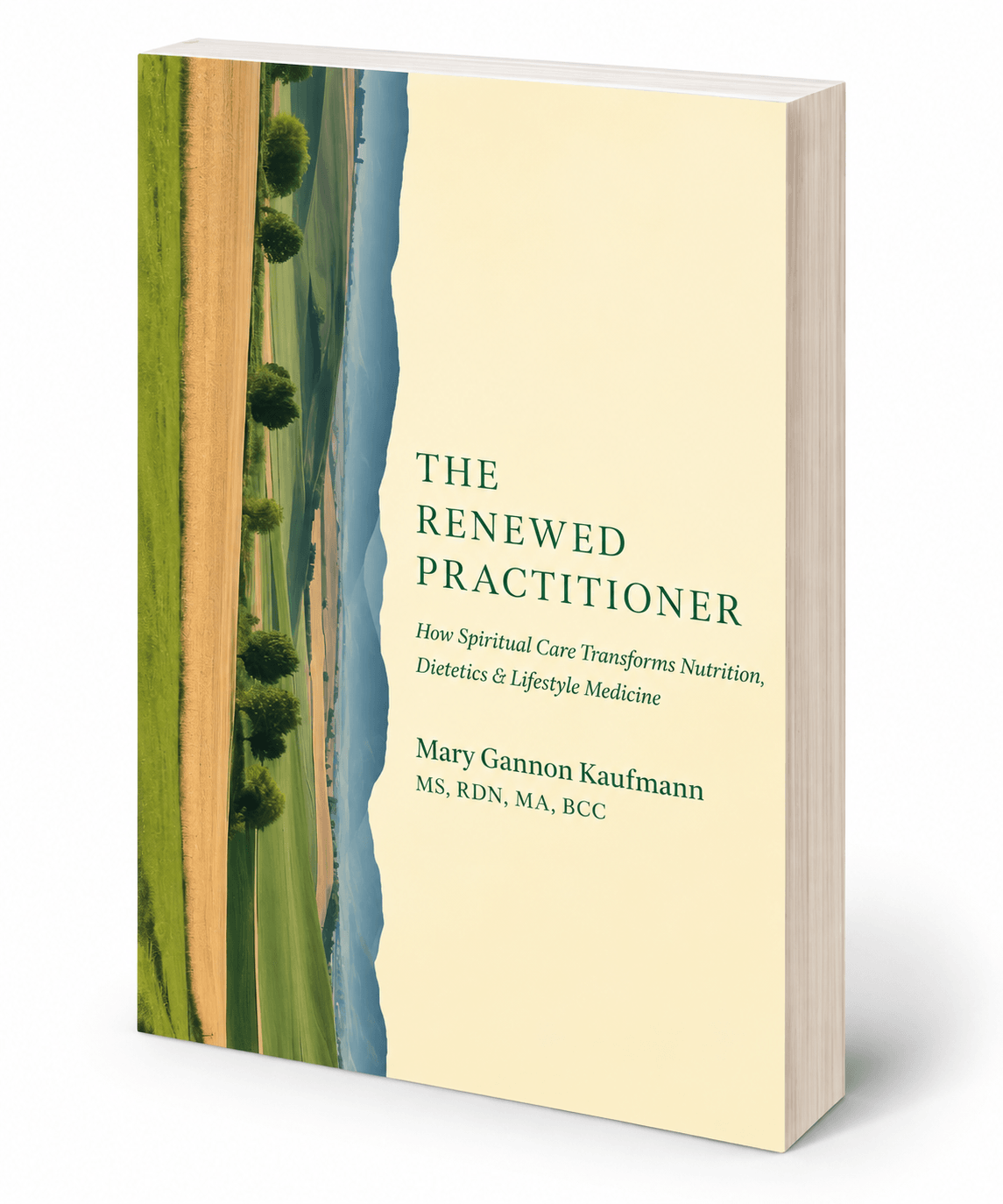
The Renewed Practitioner
How Spiritual Care Transforms Nutrition, Dietetics, and Lifestyle Medicine
Bring spiritual care into conversation with clinical practice. Explore a practical framework for recognizing and responding to the meaning, connection, hope, and resilience that shape the patient's experience.
By Mary Gannon Kaufmann, MS, RDN, MA, BCC
Keep exploring
Fresh perspectives. A deeper foundation.
Evidence & education
Meaning, Purpose & Spirituality competencies
Read the reference Mary co-authored on integrating these dimensions into lifestyle medicine education and training.
Matthews, J.A., Lianov, L., Anandarajah, G., Puchalski, C.M., Jones, N.M., Miller, C., Suhie, M.M., Frates, E.P., Gannon Kaufmann, M., Ito, S. and Smith, V.A., 2026. Integrating meaning, purpose, and spirituality (MPS) within lifestyle medicine education and training: Core competencies to support whole-person care. American Journal of Lifestyle Medicine, 20(1_suppl), pp.52S-66S.
Reflections & practical insights
Renewed Practitioner's Blog
Thoughtful perspectives on caring for the physical, emotional, social, and spiritual dimensions of health—and the practitioner who provides that care.
Learning with Renewed Practitioner
Hear From Practitioners
Practitioner reflections on the training experience.
Renee L.Registered Dietitian
Linda RNBHWC Health Coach
Ready to turn insight into practice?
Explore self-paced courses and live cohorts, with clear credit information for your profession.